All posts by elstove
SDG 7 and the ecook proposition
The world yesterday signed up for the new Sustainable Development Goals (replacing the Millennium Development Goals that were until 2015). In the new SDGs energy is now highlighted.

Goal 7. Ensure access to affordable, reliable, sustainable and modern energy for all
I am struck by the use of the various terms.
I came up with a tenth reason!
I came up with a tenth reason. In the blog Ten reasons, I cheated; I couldnt think of a tenth and just admitted it. But I have now got one….
Evolving behaviour and evolving services.
So Mobile phones has famously led on to changes in behaviour and opened the door to other approaches to regular problems. I generally call this ‘mStuff’ (because people like putting an ‘m’ to indicate the involvement of mobile phones.
mAgriculture has enhanced and has great potential to enhance agriculture and food production (see a paper derived from our report for Oxfam and HRH Prince Charles ISU unit couple years ago). mHealth has enhanced and has great potential to enhance health services throughout the world. (Yes, we are also involved with that, see our work in Bangladesh on Health information seeking), and of course Mobile Money (which we had quite a significant role in (Video)).
Anyway, after that terrible bit of self promotion let me return to the point. The mobile device (enabling communication on the move), has enabled a whole set of changed behaviour and other services. Changed behaviour – people used to give cash to a bus driver to transfer it to their up country relatives, or take 3 days off work to travel themselves – mobile money has changed the way multi-spatial households operate. Health workers were isolated and had limited backup. Now they can call for advice. Extension agents used to visit farm by farm infrequently. Now farmers can ask advice over the phone, and that changes the way they do their farming. Checking the price at a market before making the half day journey to sell your goods!
The raw behaviours already existed – asking advice, transferring money, engaging in business. But the mobile phone has enabled those behaviours to evolve, and new business services to be created. I am not saying that ecook will be a strong as the mobile phone for reshaping society, but I am saying it could enable modified behaviours and therefore open new services. (and lets me just restate – I am not saying that only cooking behaviour will change, rather that the presence of decentralised cost effective energy storage which is rolled out because it substitutes for an existing cost – is the enabler of new behaviours in farming, health and education – that whole benefit of modern energy that SDG 7 will talk about in a couple of days)
To dream an example, suppose a household has a unit. Initially it is sufficient to cook in the traditional way. However, the household become aware of the units limits and adjust their cooking behaviour to save energy (more use of a lid, insulated pots, changed timing of cooking, wonderbags). The now surplus modern energy in the battery is available for other activities. People have become familiar with the limits of modern energy and the obvious use of the surplus is charging the phone (!) and entertainment. However, they might even see that since their solar is doing such a good job on the cooking, they will explore income generating activities (such as water pumping or grinding) by adding more capacity.
Ten reasons why the uptake of ecooking may be like the uptake of Mobile Phones
 When I think about, and have the vision for, the transformation of cooking through the ecooking proposition[1], I think that there are similarities to the mobile phone revolution. There is a belief in me that once the price point is reached, and the business models are put in place, the proposition will very quickly be taken up and overcome some of the traditional barriers for electricity access and improved stoves.
It is this vision, this inspiration, which makes me want to Champion it. Here are some of the things I see in my mind’s eye – none of which are provable at the moment!
SE4All – needs a “new and transformative strategy”
The Sustainable Energy for All (SE4All) initiative has committed to achieving universal access to electricity by 2030 under. “Transforming the world’s energy systems will lead to new multi-trillion-dollar investment opportunities to eliminate energy poverty, integrate and balance conventional and renewable energy sources, address climate change and enhance prosperity in developed and developing countries alike.”
The challenge is daunting: 22 countries in the Africa Region have less than 25 percent access, and of those, 7 have less than 10 percent access. Most of the papers written on this are pessimistic. Population growth will outstrip the new supplies and they argue that “Unless there is a big break from recent trends” the population without electricity access in Sub-Saharan Africa is projected to increase by 58 percent, from 591 million in 2010 to 935 million in 2030. They lament that “more than 40 percent of Sub-Saharan Africa’s population is under 14 years old—if the current level of investment in access continues, yet another generation of children will be denied the benefits of modern service delivery facilitated by the provision of electricity.”
The World Bank states that “Achieving universal access within 15 years for the low-access countries (those with under 50 percent coverage) requires a quantum leap from their present pace of 1.6 million connections per year to 14.6 million per year until 2030.”
The language is a call for a something other than business as usual. The World Bank conceives this as a step wise change in investment – requiring considerable investment. It estimates that the investment needed would be about $37 billion per year, including erasing generation deficits and meeting demand from economic growth. “By comparison, in recent years, low-access countries received an average of $3.6 billion per year for their electricity sectors from public and private sources”. The document calls for Bank Group‘s energy practice to adopt a new and transformative strategy to help country clients orchestrate a national, sustained sector-level engagement for universal access.
Decentralised energy storage funded by the current expenditure on biomass – thats my suggested new and transformative strategy that will massively increase access to reliable modern energy.
Are we in danger of just doing what we always have done?
In the recent report THE STATE OF THE GLOBAL CLEAN AND IMPROVED COOKING SECTOR by ESMAP and GACC, they seem to have lost sight of electrcity???
In the forward to the main report Rihot Khanna states:- “This is a moment of great opportunity for the clean cooking sector. [Agreed] While experts have been working for decades on improving cookstoves and scaling up access to clean cooking fuels and technologies, only recently has this issue become a major priority on the global development agenda. The world has woken up to the serious health, environmental, and economic impacts of continued dependence on biomass for cooking. At the same time, rapid progress in technology and new financial mechanisms to support this sector have made real change possible.” The forward notes that “The three overarching SE4ALL goals to be achieved by 2030—universal access to modern energy services, doubling the share of renewable energy in the global energy mix, and doubling the rate of improvement of energy efficiency—have now been broadly accepted, including by 82 developing countries that have opted into SE4ALL.”
And yet as the report progresses there is little reference to electricity as a potential modern fuel for substituting for biomass, the great smoke killer. Radha Muthiah, Chief Executive Officer, Global Alliance for Clean Cookstoves, appeals in his opening for a vision:- “Consider, for a moment, the simple act of cooking. Imagine if we could change the way nearly five hundred million families cook their food each day. It could slow climate change, drive gender equality, and reduce poverty. The health benefits would be enormous.” He goes on to note that “Four years ago, when the Global Alliance for Clean Cookstoves (Alliance) was first launched, the issue of household air pollution and the enormous health toll that the smoke from traditional cookstoves and fuels took on the lives of women and their families in the developing world, received far less attention and funding than it deserved. Hundreds of millions of women were literally risking their lives each day to cook food for their families over inefficient cookstoves and polluting open fires, and spending hours gathering fuel often at great personal risk.” And he rightly points to the progess “With growing global attention and a shift from an aid-driven approach to a market-based one that is built on the premise of sustainability, there are now at least 20 million additional households using cleaner and/or more efficient cookstoves and fuels around the world.”
While we agree progress has been made, we see a shortsightedness that does not set the poor up for 2030. The world seems to be currently overlooking new options for clean modern fuels for cooking and this report exemplifies the emerging challenge. The momentum of local industries creating clean cookstoves that are more efficient and less polluting than open stone fires, is in danger of focusing donor and market interventions on more of the same. Without stepping back and considering what the world will look like in 2030, we will not be able to put in place the technology and market systems to move the majority of biomass consumers to clean modern fuels.
Dare I say that the Alliance for Clean cookstoves would do well to consider electricity as a potentially transformative fuel for cooking, and that this includes both grid and off grid renewable systems.
How much energy does it take to cook with electricity? Part 2
So in the last blog How much energy does it take to cook with electricity? I settled on 1.2kWh per day for a family of four.
This is important assumption because double the energy required (Balmer) and you double the cost – no brainer.
Arguably this is base load, and one may perhaps to prefer to design for peak load. But what is peak load? When 6 adult relatives descend for a 5 day visit? I would argue that under these conditions the charcoal stove is brought out of retirement. The literature points out that even in cases of improved stoves, people retain their old stoves for special occasions. In a standard kitchen in the West we have at least 6 devices for cooking (kettle, toaster, stove, oven, etc). Therefore it seems reasonable to design for the base load at the start and leave the peak loading to other devices – until electricity has become so common and so cheap that all cooking can be catered for (excuse the pun).
Some other random notes:-
- Much of our food here in UK is pre –processed. Pasta takes so little to cook because it has already had energy invested in it during manufacture. There are reports on how much energy it takes to cook pasta, but these are not so relevant to Africa.
- Before I found Cowan 2008, which gave me experimental real world data on how much energy a meal took to cook, I undertook my own theoretical compilation of energy requirements. I gathered all the recipes I could find for African meals from the internet. Unpacking the stated recipes into its stages ‘bring to boil’, simmer for 1 hour’ etc, I assigned energy per minute to each stage. The result was the following graph. However this is based on certain assumptions about the energy for each stage, so changing simmering from say 150W to 200Wmakes a lot of difference. Spreadsheet available.

- 150W or 200W for simmering. This actually depends on whether there is a lid for the pan or not. And this moves into behaviour change territory. The actual energy used per meal will depend on whether households can be encouraged to adopt energy efficient behaviour. The lid is the case in point! Putting a lid on simmering food makes a huge difference. Therefore I am assuming that an educational campaign is attached to any roll out of electric cooking, showing people how they can maximise the use of the energy they have (and minimise the consumption).
- Colleagues in Bangladesh and Nottingham have taken this thought one step further and have worked on insulating the immediate cooking area (not the pot per say but retaining the heat near the pot). A student project in Nottingham was able to reduce the energy required for cooking by 60% (electric heating of a pan of soup). Potentially then, the 1.2KWh could be reduced. I see this as a latter stage to any planned scaling of shifting households from biomass to electricity. I assumed we would start with a simple hot plate that would take any existing pot.

Cowan 2008 Alleviation of Poverty through the Provision of Local Energy Services APPLES (Project no. EIE-04-168) Project Deliverable No. 17: Identification and demonstration of selected energy best practices for low-income urban communities in South Africa
Balmer, M. 2007. Energy Poverty and cooking energy requirements: The forgotten issue in South African energy policy? Journal of Energy in Southern Africa, Vol, 18, No.3
How much energy does it take to cook with electricity?
This is a very key question for the proposition. Most writing about African cooking is based on biomass cooking. Even with improved stoves control of the cooking process is nowhere near to that given by LPG gas, Kerosene, even ethanol gel, and of course electricity. It is this control that reduces the amount of energy required.
A key revision of energy required for cooking is found in Balmer (2007). He states:-
“The World Energy Council (1999) found that daily cooking energy consumption per capita varied from 11.5 to 49 MJ, based on field measurements. Despite a wide range of locations and conditions, the range of consumption is quite small. In households where modern cooking energy sources and equipment are used, and the preparation of partially cooked food is common, specific fuel consumption is found to be in the region of 2 to 3 MJ/capita/day.” Balmer 2007
However, even here although he acknowledges that modern energy requires a lot less than biomass, he does not dig into the details of the amount of energy required with modern cooking. Indeed I am not sure where he gets his 2 to 3MJ/capita/day which is 2.2 to 3.3KWh per day per household of 4 person.
As you will know electricity is barely used in Africa for cooking, even among the elite. The reasons include price but are more often stated as variations on the theme of unreliability. I would argue that also Governments do not encourage use of electricity for cooking because it inevitably would add to the peak load, which they are already struggling with.
The one exception to the rule ‘Africans barely use electricity for cooking’ is South Africa. With a steady supply and a level of wealth higher than many other African countries, it is possible to find people cooking with electricity. To me this is important as it speaks to the effect of the price point (IF reliability is there) and to the behavioural change question. Also from South Africa we can nuance how much energy it takes to cook an African meals.
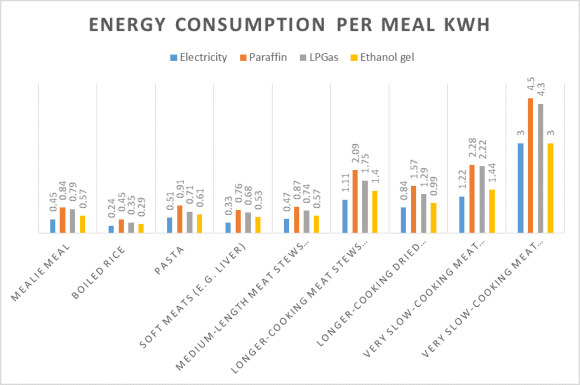
The key work I have found is Cowan 2008. Bill Cowan from University of Cape Town, as part of a EU funded project, actually got 80 households (household of 4) to cook with various fuels and measured their consumption. He tried different categories of meals from rice and pasta, to the long slow cook of offal meat. I attach an extract of his outcome.
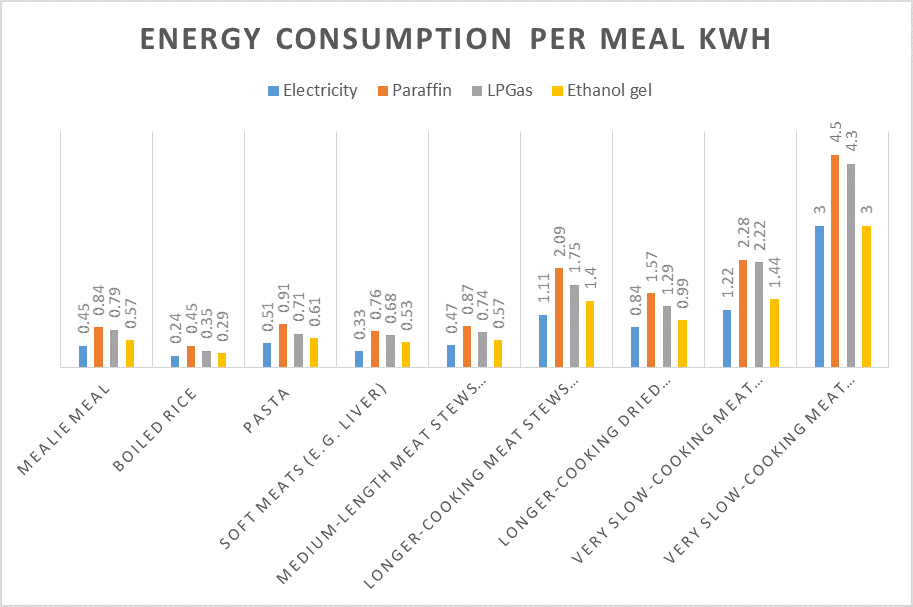
The bottom line to me is that a meal that has good meat takes about 0.5kWh (of electricity to cook), while a long slow simmering of offal or very poor cuts of meat can take over 1kWh.
Other works tell us that the norm for poorer sections of Africa (and indeed the world) is two meals a day, while the poor can sometimes be reduced to one meal a day. It is true that aspirational is three meals a day, but I don’t believe a design should be based on this.
Logic then suggests that these two meals are unlikely to both be long slow simmering of offal. One may be a long burn, while the other is a reheat of yesterdays food. Similarly, there may be two rice based meals.
I have therefore in my calculations and notes so far taken 1.2kWh of useful electricity as my average requirement per day for a household of four.
Nottingham University student Project
We sponsored a final year student project at Nottingham University to explore the ecook proposition. They have focused on reducing the energy required for cooking. Very interesting. They can reduce the heat loss from 152J/s to 52J/s. Something like 60% savings. They make the point that it is temperature that cooks food not energy per se. Keep the temperature and you ‘keep’ the cooking.
They also propose an interesting use of the system, where if its used while there is sunshine, then actually the battery size can be smaller than I had originally proposed AND still has charge left over for lights in the evening.
A jolly well done to them – some good ideas here. And my thanks to Mike Clifford, who set it up for us, and who has some really interesting ideas on phase change material. (Next year I think we will sponsor exploration of combining solar PV with phase change materials. And Mike is in the middle of an interesting research on Barriers to Improved Stoves.)

Solar Electric Cooking: Concept Video
Practical Action who we are working with in Rwanda, asked me to make a 3 (okay more like 5) minute video on the concept for their strategy workshop in Zimbabwe, which I happily did, and share with you below.
 Solar Electric Cooking