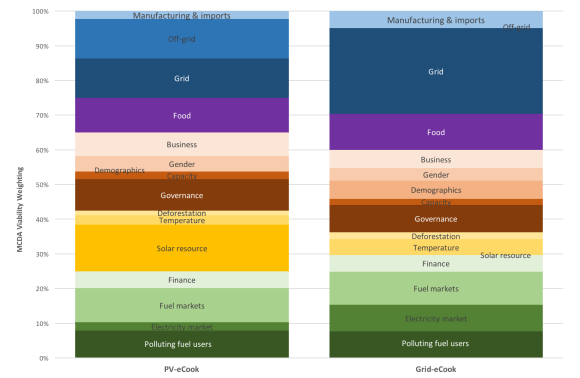
 Cumulative weightings for each factor under the PV-eCook (left) and Grid-eCook (right) weighting sets.
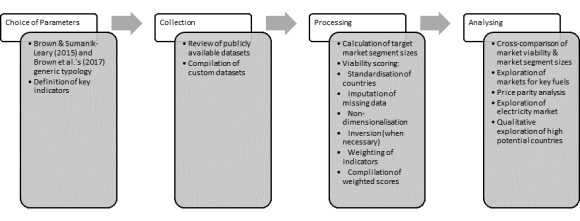
This study employs MCDA techniques to quantitatively compare countries according to the viability of eCook in each particular country context. Weightings were assigned to each indicator, sub-category and category to balance out their relative influence over the final result. Simple Multi-Attribute Ranking Technique (SMART) was selected as the most appropriate MCDA technique for this study, as it is simple to understand (it is similar in nature to the well-known cost-benefit analysis) and is relatively streamlined (it only requires one decision to be made per indicator, sub-category and category). Read more…

 16 countries scoring highly in either PV- and/or Grid-eCook viability (highlighted in red in Figure 9 and Figure 10), were shortlisted for detailed investigation based on one or more of the following reasons:
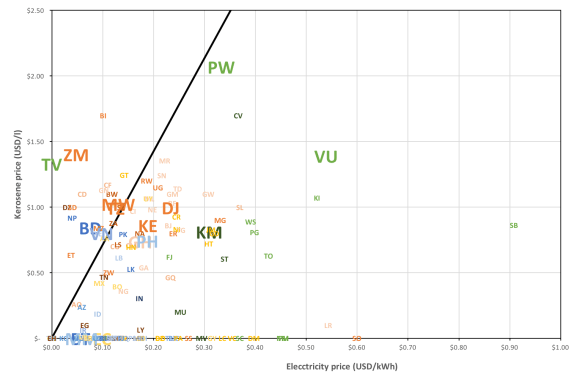
 The viability scores above do not embody the number of people living in each country (and therefore potential market size), nor the cost comparison of the three target fuels with grid electricity. The following section seeks to explore in greater depth how these critical market dynamics might influence the choice of early markets.

 PV-eCook and Grid-eCook have very different target markets. PV-eCook is targeted at regions where no grid infrastructure exists (nor is it likely to in the near future), i.e. rural off-grid HHs. From a system-level perspective, Grid-eCook offers the ability to rebalance and reinforce weak grid infrastructure. As a result, the key target market segments are expected to be those living at the fringes of the grid, where the infrastructure is weakest, i.e. urban slums or rural grid-connected HHs .
 Solar Electric Cooking